 Start a reading
Divination · Samhain
When the Veil Grows Thin: Samhain, Intuition, and the Spaces Between Worlds
Samhain is a season of thresholds: harvest and winter, memory and mystery, the visible and unseen. Explore what it means when we say the veil between worlds grows thin.
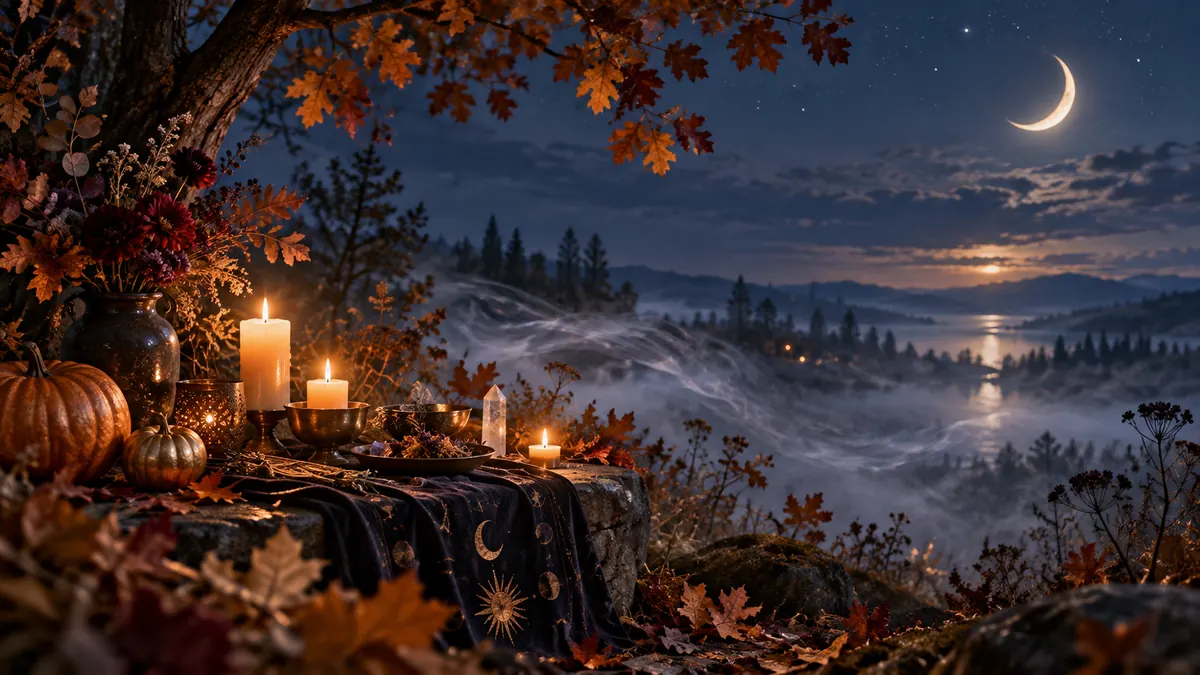
There is a particular feeling to the weeks around Samhain. The light changes first. Afternoon seems to fold into evening more quickly, shadows lengthen earlier than expected, and the natural world begins to withdraw into itself. Leaves dry and loosen. Gardens fade. Branches emerge where dense summer growth once hid them. The year feels less expansive and more inward-facing, as though the world itself is turning from display toward reflection. It is easy to understand why this season became associated with thresholds, endings, memory, and the unseen.
Samhain has deep roots in Gaelic seasonal tradition. Historically, it marked the beginning of winter on November 1, with much of the traditional observance taking place the evening before. Irish folklore also associated the season with divination, remembrance of the dead, protection of the household, feasting, and the possibility that the dead might return to the family home. The modern language surrounding Samhain has accumulated many additional layers, but those older traditions give us something more interesting than a generic “spooky season”: a moment in the calendar when ordinary boundaries were understood to become less certain.
One of the most enduring modern descriptions of Samhain is that the veil between worlds grows thin. It is a beautiful phrase, repeated so often that it can easily become decorative language—something printed on candles and social media graphics without much thought. Taken seriously, though, the idea is far more interesting.
What Do We Mean by “the Veil”?
The veil is not something you can reach out and touch. It is a metaphor for the boundary between what is ordinarily visible and what is not. Depending on your beliefs, that can mean the living and the dead, the material and spiritual, the conscious and unconscious, the rational and intuitive, or simply the known and unknown.
For some people, the phrase is literal: Samhain is a time when spirits, ancestors, or other presences may feel closer. For others, it is psychological and symbolic: the season encourages stillness, memory, and heightened attention, which can make subtle impressions easier to notice. Those interpretations do not have to compete. A person can remain uncertain about metaphysics while still recognizing that certain times, places, and practices change the quality of attention.
That change in attention may be one of the most important parts of Samhain practice. Daily life is noisy. We move from message to message, task to task, obligation to obligation, often without noticing how much information passes through us without being consciously processed. Intuition rarely arrives as a dramatic command. More often it appears as a hesitation, a memory, a recurring symbol, a sudden certainty with no obvious source, or a dream that refuses to fade after waking. Much of what we call intuition may involve subtle pattern recognition, emotional knowledge, memory, observation, or unconscious processing. Some people understand it as something more. Either way, it generally becomes easier to hear when life becomes quieter.
A Season Built Around Thresholds
Samhain naturally lends itself to that quiet because its imagery is full of retreat and transition. The harvest has ended. What was once growing outward begins to collapse inward. Plants die back above ground while roots and seeds remain hidden below. Trees lose the leaves that made them seem full, yet nothing essential has vanished. The life of the plant is simply no longer where we can easily see it.
That seasonal truth helps explain why Samhain lends itself so readily to thoughts of death and continuity. The world appears emptier, but the emptiness is deceptive. Beneath the surface, life is waiting.
The threshold itself matters. Samhain sits between harvest and winter, abundance and dormancy, light and darkness. Folklore surrounding the season similarly blurs familiar divisions: between the household and the outside world, the living and their dead, and what can and cannot ordinarily be known. Traditional Irish Samhain customs even included forms of fortune-telling and divination alongside feasting and remembrance.
That makes Samhain more than a festival about endings. It is a season concerned with what remains after an ending, what travels across a boundary, and what can be perceived when familiar structures fall away.
Remembering the Dead Without Making Them Frightening
Modern Halloween imagery often turns death into spectacle, but Samhain does not require fear. Irish tradition included the belief that the souls of the dead might return to the family home, and remembrance of those who had died became part of the seasonal landscape.
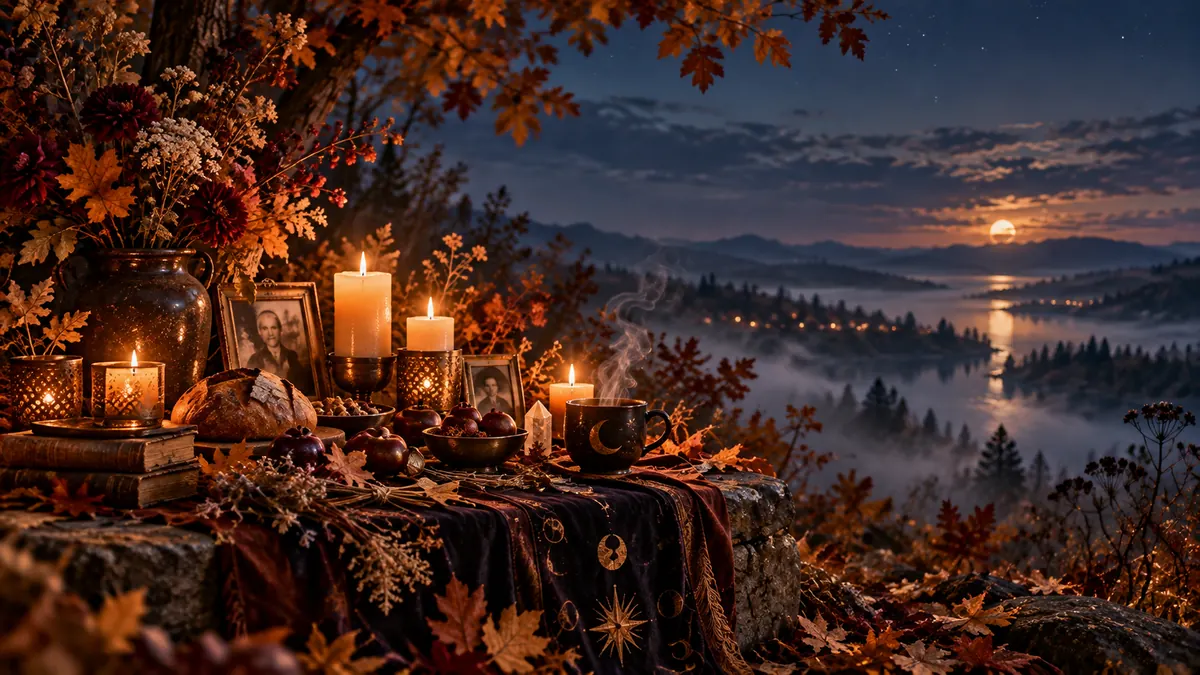
Remembering the dead can also be intimate, practical, and ordinary. It can mean preparing a meal associated with someone who died, lighting a candle beside an old photograph, telling a family story that has not been spoken aloud in years, listening to a song that belonged to a particular time in your life, or simply saying someone’s name.
None of these acts requires a belief that the dead are literally present. Remembrance itself creates a kind of presence. A person can be gone and still exert influence through memory, habit, language, family stories, values, recipes, gestures, and choices passed from one generation to the next.
For those who do believe in spirit communication or ancestor contact, Samhain may feel especially significant. But the most useful approach is not to force an experience. There is a temptation in spiritual practice to expect something dramatic: a sign, a voice, a vision, an unmistakable message. That expectation can make us less observant rather than more. If you are trying too hard to experience something extraordinary, you may overlook the quieter impressions that actually matter. A scent that triggers a memory, an unexpected dream, a familiar phrase that comes to mind, or a recurring image can be more meaningful than anything theatrical.
Divination at Samhain
Divination practice fits naturally into this season for the same reason. Tarot readings, runes, scrying, dreamwork, and similar practices interrupt ordinary thought. They create a deliberate pause and ask us to look differently at a question. Historically, divination was part of Irish Halloween and Samhain custom as well; some traditional games attempted to foretell marriage and future fortune.
At Samhain, I prefer divination that focuses on transition rather than simple prediction. Questions such as What am I ready to leave behind? or What pattern am I carrying forward without realizing it? are often more useful than asking what will happen next. Samhain is already a season of endings and beginnings, so the most powerful readings tend to explore what is changing, what is being released, and what may be emerging underneath the surface.
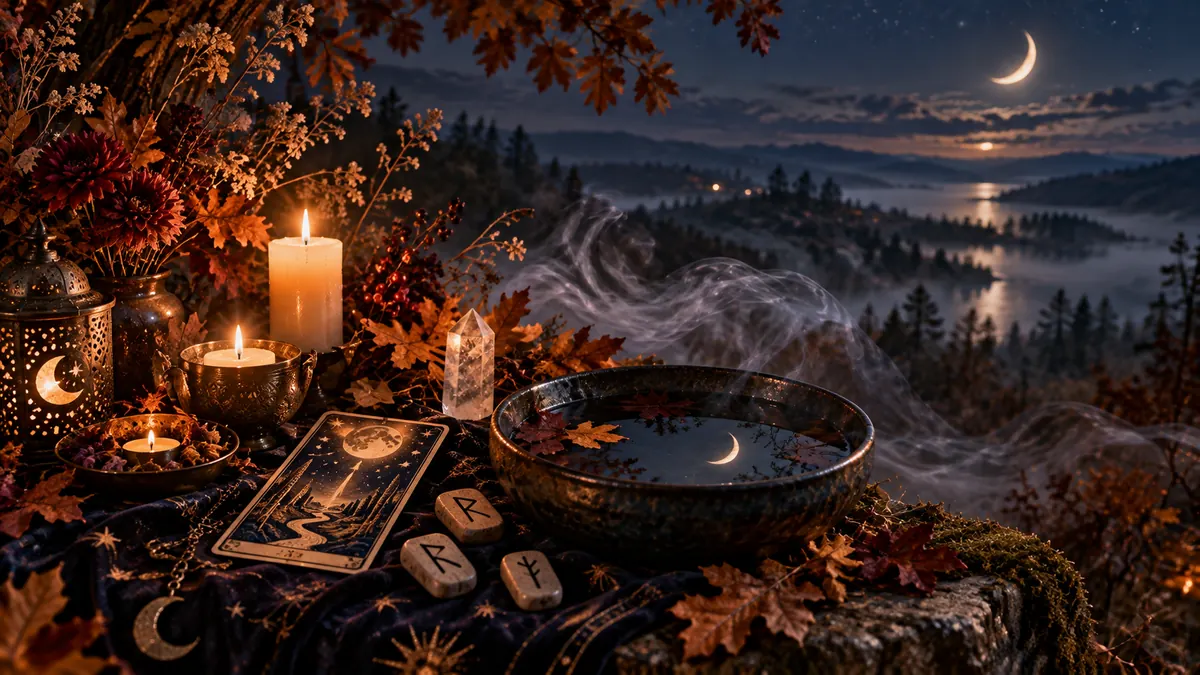
A tarot spread during this period might examine what has reached its natural conclusion, what remains unresolved, what wisdom can be carried forward, and what deserves to be left in the past. A rune casting might focus on what is being inherited, what is being transformed, and where resistance is creating unnecessary difficulty. Water scrying can be especially effective because it asks for observation before interpretation. Whether you use a dark mirror, a bowl of water, a candle flame, or a crystal ball, the discipline is much the same: notice first, assign meaning later.
That sequence matters. One of the easiest mistakes in divination is to interpret too quickly. A shape appears in water and immediately becomes a message. A tarot card is pulled and the reader rushes to its guidebook meaning. A dream includes a bird and suddenly the bird must symbolize freedom, death, hope, or warning. Personal symbolism is often more useful than generalized symbolism. A bird may mean freedom to one person, grief to another, and absolutely nothing to someone else. Samhain encourages mystery, but mystery does not require us to abandon discernment.
Not Every Flicker Is a Message
Not every flicker is a sign. Not every dream is prophetic. Not every strange sound in the house is a spirit. Candles move because of drafts. Minds make patterns because that is what minds do. Coincidences happen. A grounded spiritual practice leaves room for these explanations without treating them as failures.
Skepticism and intuition are not enemies. In fact, a little skepticism protects intuition from becoming fantasy. If something feels meaningful, write it down. See whether it repeats. Notice whether a pattern develops over time. The important experiences tend to survive scrutiny.
This is one reason journaling becomes especially valuable during Samhain. Dreams, impressions, repeated symbols, unusual coincidences, memories, and emotional shifts are easy to forget when they are isolated. Written down over several days or weeks, they become easier to evaluate. A pattern that seemed invisible in the moment may become obvious later. Perhaps the same image appears repeatedly in dreams. Perhaps one theme keeps turning up in tarot readings. Perhaps a particular ancestor or family story keeps resurfacing.
Recording first and interpreting second allows meaning to emerge rather than forcing it.
A Simple Samhain Listening Practice
A Samhain practice does not need to be elaborate. Dim the room. Light a candle if it is safe to do so. Put away your phone. Sit for a few minutes without immediately reaching for cards, runes, or a journal. Let the room become quiet.
Then choose one question you actually care about.
Not ten questions. Not a list. One.
You might ask what you are ready to release, what needs to be understood before the season turns, or what part of your own history deserves more attention.
If you use tarot, draw a single card and study the image before looking up its meaning. Notice what your eyes are drawn to first. If you use runes, notice your immediate reaction before interpreting the symbol traditionally. If you scry, write down shapes, colors, movement, or impressions before deciding what they mean. If you work with dreams, leave a notebook beside the bed and record whatever remains when you wake, even if it seems fragmented or strange.
The goal is not to produce a mystical experience on command. The goal is to become more observant. If you are new to these practices, the Starter Kit offers a simple introduction to tarot, runes, scrying, dreams, crystals, and intuitive observation.
What We Inherit
Samhain is also an excellent time to think about inheritance in the broadest sense. We inherit more than names, possessions, and genetics. We inherit habits, fears, family myths, attitudes toward money, beliefs about love, survival strategies, cultural traditions, ways of speaking, and ideas about what is possible.
Some of those inheritances are gifts. Some are burdens. Some are both at once.
The season’s connection with ancestors can therefore be understood not only as looking backward toward the dead, but as examining what the past continues to do inside the present. What family pattern are you repeating? What belief did you inherit without ever consciously choosing it? What strength came from people before you? What are you carrying because it once helped someone survive, even if it no longer helps you?
These are deeply Samhain questions because they live at the boundary between past and present. They ask us to consider what remains after something ends.
Standing at the Threshold
The idea of a thin veil becomes most useful when it stops being theatrical. It does not need ghosts in the hallway or dramatic supernatural encounters. It can be as simple as becoming more sensitive to the things we normally miss. Memory feels closer. Dreams become more vivid. Patterns stand out. The past feels less distant. Silence feels more inhabited.
Whether that is spiritual, psychological, symbolic, or some mixture of all three is a question each person has to answer for themselves. There is something valuable in not answering too quickly.
Samhain is a threshold, and thresholds are places of uncertainty. They are neither one room nor the next. They exist in between. That is why they can feel uncomfortable, powerful, and strangely alive. We are accustomed to trying to resolve uncertainty as quickly as possible, but not every unknown needs to be immediately solved. Sometimes it is enough to stand at the edge of something and pay attention.
If you want help exploring a question that has been sitting at the edge of your awareness, psychic readings offer another way to look more closely at what you are noticing.
As the darker season approaches, this is a good time to slow down and notice what has become harder to ignore. Light a candle. Pull a card. Record a dream. Remember someone. Sit quietly enough to hear the thoughts that only appear when everything else stops demanding your attention.
Maybe the veil really does grow thin.
Maybe we do.
And perhaps, for a little while, that is enough.
Topics: Samhain · thin veil · intuition · divination · tarot · runes · scrying · ancestor remembrance · dreamwork